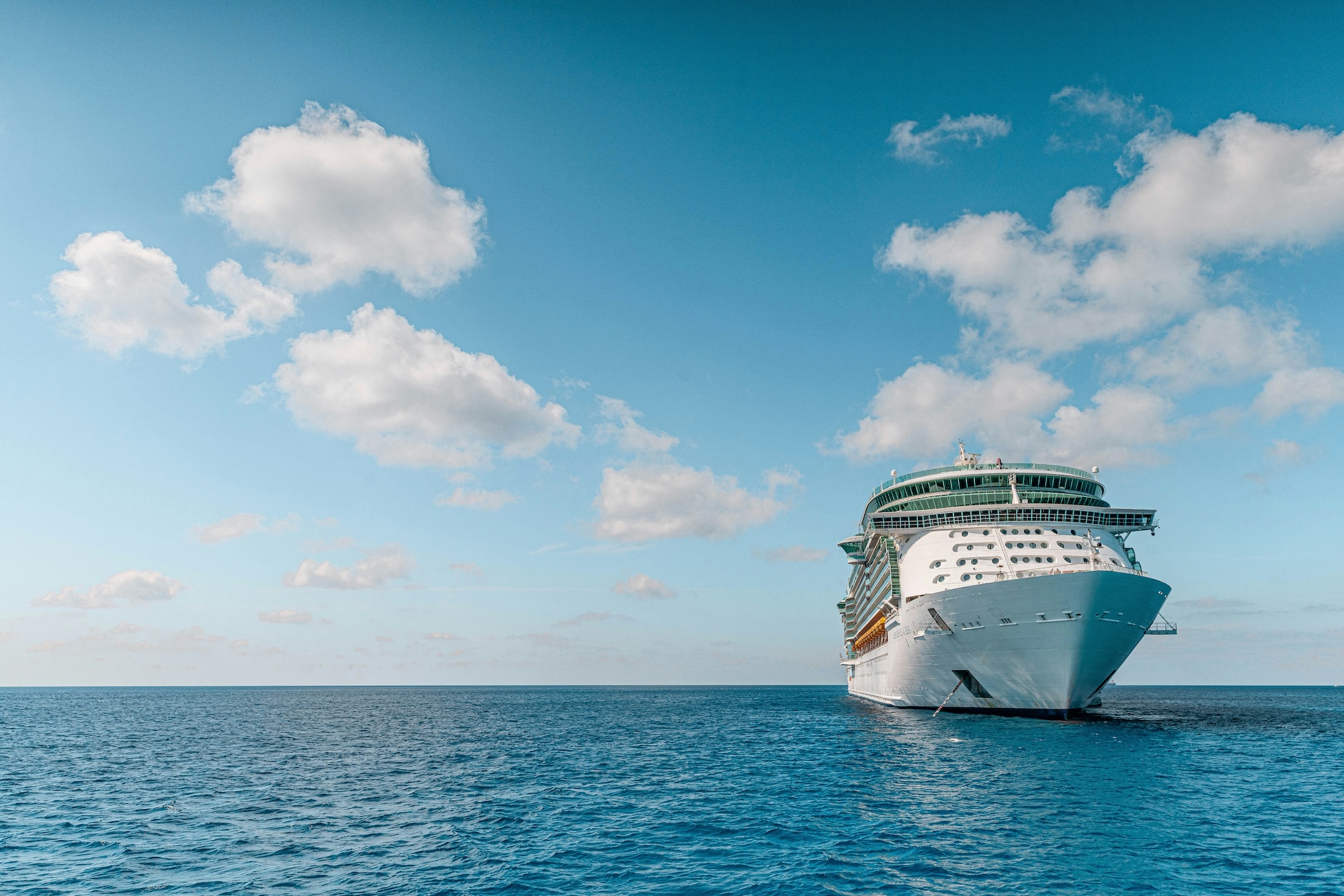

MS Fjord Serenade at sea

Norwegian Fjords · MS Fjord Serenade

Five fjords, one country, eight days

Stavanger, Bergen, Geiranger, Ålesund and Flåm in eight days – with two sea days, UNESCO fjord scenery, all port times and the route on the map.

Home › Routes › Norwegian Fjords

Europe’s north at walking pace

Five ports on one coast, two sea days and no need to pack a beach towel: the fjord route trades city-hopping for scenery.

Between the North Sea and the innermost arms of the fjords lie around 1,050 nautical miles of coastline where the water is deep, the villages small and the mountains start directly above the harbour. The legs are short, the evenings are long, and every morning the ship is already deep inside a landscape you otherwise only see from a viewpoint.

The MS Fjord Serenade sails this route between May and early September. The ship carries around 2,400 guests, has a shallow draft that lets it enter the narrow fjords, and a panorama deck at the front that fills up early on the approach to Geiranger.

In this article you will find:

  • All five ports with arrival, departure and port times
  • Distances from the quay to the centre – on foot, by shuttle, by funicular
  • The best time to travel by weather, daylight and crowds
  • A realistic cost breakdown for a country where nothing is cheap
  • The complete route as a map

Create this route as a map

The route as a common thread

Five ports, one deep coastline

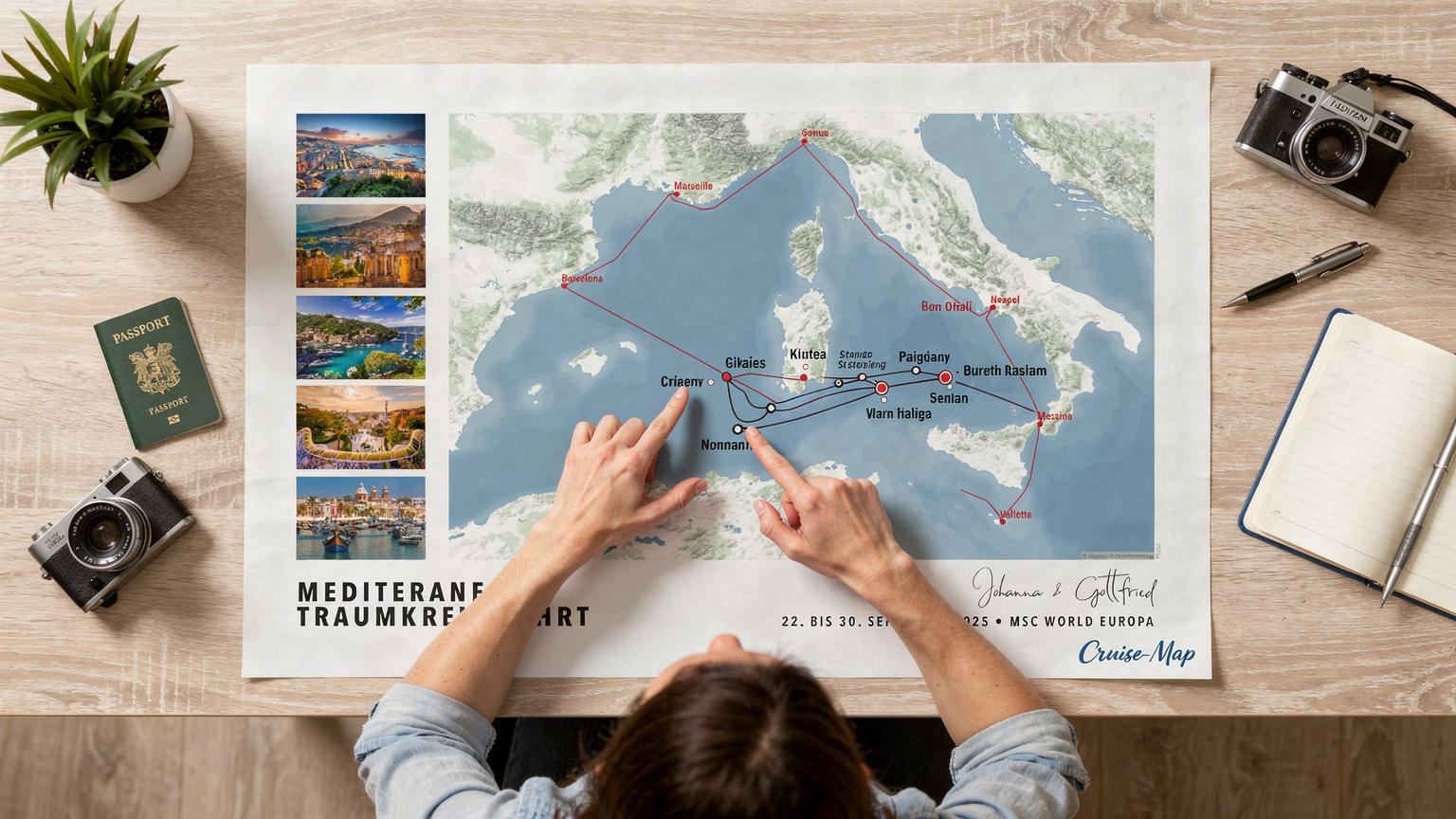
A list of ports describes a journey as an enumeration. A map shows it as movement: how quickly the ship leaves the North Sea behind, why Flåm sits at the end of the longest arm, and where the two sea days appear.

The CruiseMap does not draw the straight line between two ports but the path the ship actually took – including the turns into the Geirangerfjord and the Nærøyfjord.

  • All five ports with name and position
  • The sailed sea route instead of straight connection lines
  • Ship name and travel period in the title block
  • As a file for your phone, a print for your living room or a puzzle

Create your own map

Day 1Southampton
dep 17:00

Day 2Stavanger
12:00–20:00

Day 3Bergen
08:00–17:00

Day 4Geiranger
09:00–18:00

Day 5Ålesund
07:00–16:00

Day 6Flåm
08:00–19:00

Day 7Sea day

Day 8Southampton
arr 07:00

Schedule

The journey at a glance

Times are taken from the published itinerary of the line. Deviations of 30 to 60 minutes are normal, especially when a fjord is entered through a narrow arm – the notice board on board is always binding.

Schedule of a typical 8-night round trip from Southampton. The order of ports can vary by departure date.
Day Port Country Arrival Departure Port time
Day 1 Southampton United Kingdom Embarkation 17:00 All day in port
Day 2 Stavanger Norway 12:00 20:00 8 hours
Day 3 Bergen Norway 08:00 17:00 9 hours
Day 4 Geiranger Norway 09:00 18:00 9 hours
Day 5 Ålesund Norway 07:00 16:00 9 hours
Day 6 Flåm Norway 08:00 19:00 11 hours
Day 7 Sea day North Sea – – –
Day 8 Southampton United Kingdom 07:00 Disembarkation –

The ports

Six days, one coast

Every port on this route lies directly on the water and within a short walk of its centre. What differs is the scale: a wooden old town, a UNESCO wharf, a fjord village at the end of a mountain road.

Gamle Stavanger, the white wooden houses
Gamle Stavanger: around 170 white wooden houses, most of them still lived in.

Day 2 · Stavanger, Norway · 12:00 – 20:00 · 8 hours

The gateway with the white wooden lanes

Stavanger is the first Norwegian port and the gentlest introduction: the ship docks at the Vågen, right below the old town. From the gangway it is a two-minute walk to Gamle Stavanger, one of Europe’s best-preserved wooden-house quarters – about 170 white-painted houses from the 18th and 19th centuries, most of them still lived in, on lanes so narrow no car fits.

Further along the harbour, the Norwegian Petroleum Museum explains what made the city rich, and the brightly painted street Øvre Holmegate is a few minutes inland. The Preikestolen plateau, the famous flat rock 604 metres above the Lysefjord, lies 25 kilometres away and needs a three- to four-hour hike plus ferry crossings – not possible inside eight hours.

Our tip

Keep Stavanger on foot. The old town, the harbour and the museums sit within a 15-minute radius, and that leaves time for a proper lunch of fish soup instead of a rushed boat to the fjord. Finish at the Valberg Tower for the view over the bay.
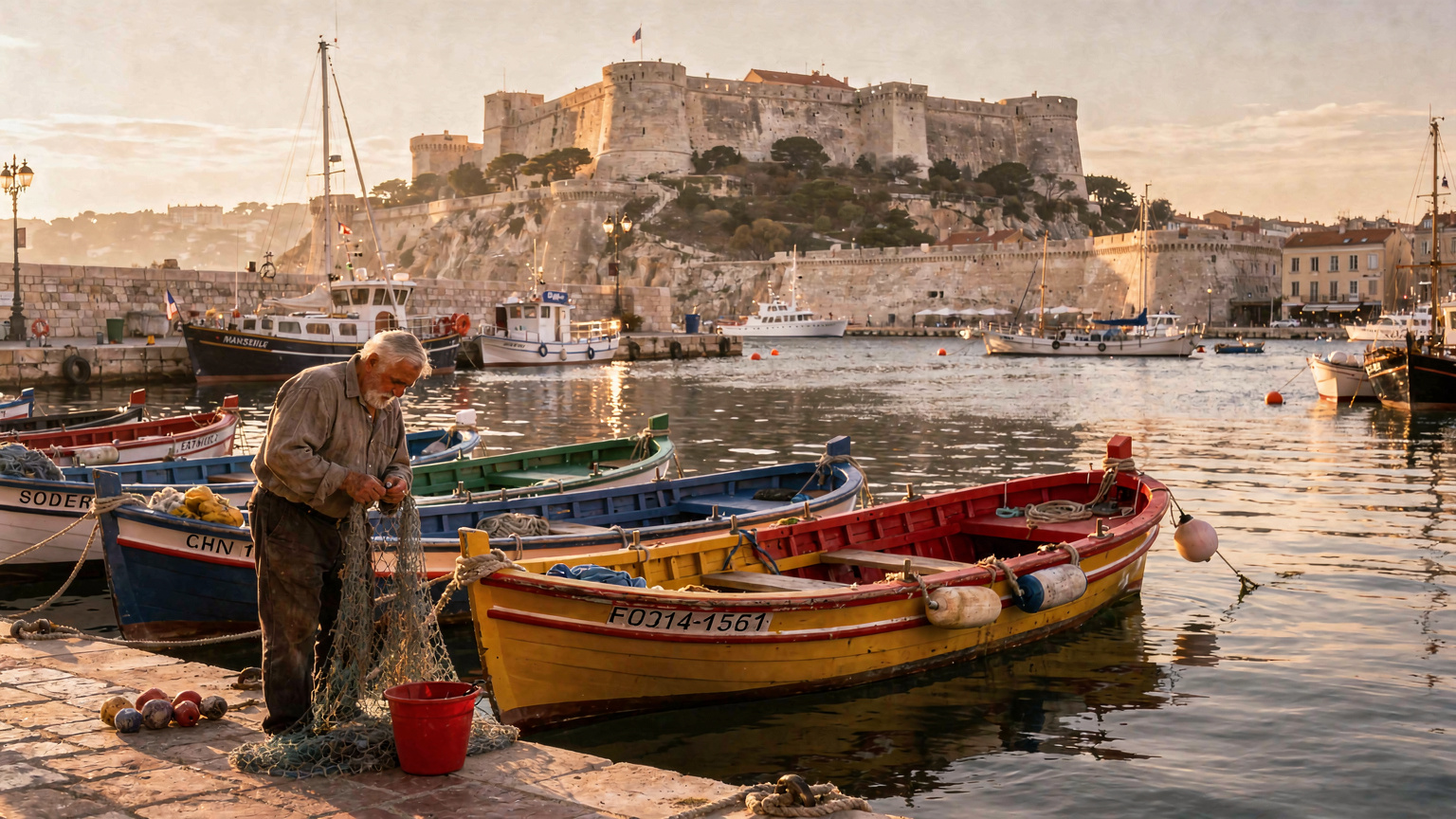

Bryggen in Bergen
Bryggen: the Hanseatic wharf has been a World Heritage Site since 1979.

Day 3 · Bergen, Norway · 08:00 – 17:00 · 9 hours

The city between seven mountains

Bergen greets you with a working harbour. The ship usually lies at Bontelabo or Skolten; from either it is a ten-minute walk to Bryggen, the row of gabled wooden warehouses that has stood on the wharf since the Hanseatic era and has been a UNESCO World Heritage Site since 1979.

Behind it are the fish market and the lower station of the Fløibanen funicular. The funicular climbs 320 metres to Mount Fløyen in about seven minutes, and from the top the city, the fjords and the islands lie below. For the rain Bergen is famous for, the KODE art museums and the aquarium are the indoor plan – the city records around 200 rainy days a year.

Our tip

Take the funicular up early, before the cruise crowds arrive, and walk back down through the forest paths. The route down takes about 45 minutes and passes a lake, a playground and a goat enclosure.

Geirangerfjord with the Seven Sisters waterfall
The Geirangerfjord: a UNESCO World Heritage Site, entered by tender.

Day 4 · Geiranger, Norway · 09:00 – 18:00 · 9 hours

The fjord everyone photographs

Geiranger is the reason people book this route. The ship anchors at the head of the Geirangerfjord – a UNESCO World Heritage Site – and guests go ashore by tender. Already on the approach, the Seven Sisters and the Suitor waterfalls fall into the fjord on opposite sides, and the abandoned farm at Skageflå hangs on the cliff 250 metres above the water.

In the village, the Fjord Centre explains the geology and the old mountain farms, and the Fossevandring staircase follows the waterfall by the church up through the village. The viewpoints are the real draw: Eagle Bend, eleven hairpin curves above the fjord, and Dalsnibba, a summit at 1,476 metres with a glass platform looking straight down on Geiranger.

Our tip

Choose one viewpoint, not both. Dalsnibba needs a bus and around three hours, Eagle Bend about 90 minutes. If the sky is clear, Dalsnibba wins; if it is low cloud, Eagle Bend is far more often open.

Art Nouveau houses in Ålesund
Ålesund was rebuilt in stone after the fire of 1904 – in pure Art Nouveau.

Day 5 · Ålesund, Norway · 07:00 – 16:00 · 9 hours

The Art Nouveau town

Ålesund burned down once, in 1904, and was rebuilt in stone in the Jugendstil style within a few years – which is why the whole centre today looks like one continuous Art Nouveau drawing. The ship docks in the middle of it, and the Jugendstil Centre, the fishing museum and the harbour promenade are within a few minutes’ walk.

The classic view is from Mount Aksla: 418 steps from the town park lead to a terrace 189 metres above the sea, with the archipelago spread out below. For families the Atlantic Sea-Park, one of the largest saltwater aquariums in northern Europe, is a reliable indoor option when it rains.

Our tip

For photographs, be at the Aksla terrace in the morning light before the excursion buses arrive. The stairs are steep but shaded by trees, with benches the whole way up.

The Flåm Railway on the climb to Myrdal
The Flåmsbana climbs 866 metres in 20 kilometres – through 20 tunnels.

Day 6 · Flåm, Norway · 08:00 – 19:00 · 11 hours

The longest port time and the steepest railway

Flåm lies at the innermost end of the Aurlandsfjord, a branch of the Sognefjord, and has the longest port time of the week – eleven hours, deliberately. The village itself is tiny: a handful of houses, a railway station, a brewery and a museum. The reason for the time is the Flåm Railway, the Flåmsbana, one of the steepest standard-gauge lines in the world.

In 20 kilometres it climbs from sea level to 866 metres at Myrdal, through 20 tunnels and past the Kjosfossen waterfall, where the train stops for photographs. The round trip takes about two hours. Above the village, the Stegastein viewpoint juts 30 metres out from the mountainside, 650 metres above the Aurlandsfjord, and the Nærøyfjord, the narrowest arm and also UNESCO-listed, is best seen from the water.

Our tip

Book the Flåmsbana in advance and take an early departure. With eleven hours you can combine the train with Stegastein or a fjord cruise on the Nærøyfjord – but only if you start by 09:00, because the last departures fill up.

Open water on the North Sea crossing
The North Sea passage is the only long stretch of the week.

Day 7 · Sea day · the way back across the North Sea

The day the coast disappears

From Flåm back to Southampton the ship crosses the North Sea – the only long passage of the week and the reason the day lies entirely at sea. This is open water, not a sheltered fjord: the swell here can be noticeably livelier than anywhere else on the route, and the first morning is the one to plan for if you are prone to seasickness.

Most people use the day for the spa and the panorama lounge. The captain often schedules a lecture on the fjord landscape or a bridge visit, and the sun decks are busiest around midday.

Good to know

If the North Sea is rough, the panorama lounge fills up early. The forward deck is the calmest place on the ship and the warmest view when the weather closes in.

Five ports, one language, and still no two days that look alike.

Norwegian Fjords

Why this route works

Scenery instead of city-hopping

Five qualities distinguish this route from a Mediterranean itinerary – and explain why it keeps selling out for June.

5

Deep-water ports

All five lie directly on the fjords or the open coast, four of them within a ten-minute walk of the centre.

3 of 5

Ports with UNESCO World Heritage

Bryggen in Bergen, the Geirangerfjord, and the Nærøyfjord near Flåm.

18 hrs

Daylight in June

At midsummer the sun barely sets, so evening walks and late photography are possible until midnight.

2

Sea days

One at the start across the North Sea, one at the end – enough rest without losing port time.

11 hrs

Longest port time

Flåm gets a full day, exactly what the railway, the viewpoints and the Nærøyfjord need.

1,050

Nautical miles total

Short legs inside the fjords, two open passages at the ends. Exactly this distribution is what the map shows.

Assessment

Is this route right for you?

You will like this route if …

  • You travel for landscape, not for cities. The ports are small; the scenery between them is the destination.
  • You prefer cool air to heat. In June the coast sits around 16 °C, and the nights on deck are fresh.
  • You travel with teenagers. The railway, the viewpoints and the fjord safari beat another museum.
  • You photograph. Long daylight, deep water and moving light – the route is built for a camera.
  • You want a relaxed pace. Five ports in eight days, all a short walk from the quay.

A different route fits better if …

  • You want warm water and beaches. The Norwegian coast is for looking, not for swimming.
  • You need big-city nightlife. After 22:00 most of these towns are quiet.
  • You get seasick easily. The two North Sea crossings are the roughest part of the trip.
  • You want many countries. This route stays in Norway the whole week.
  • You are on a tight budget. Norway is one of Europe’s most expensive countries, and the extras add up fast.

Best time to travel

June for daylight, early September for quiet

The route runs from May to early September. The difference between the seasons lies less in the temperature than in daylight, crowds and price.

Spring

April and May

Air5–12 °C
Water6 °C
Sun6 hrs/day
Rain days10 per month
Crowdslow

The waterfalls are at their fullest from the snowmelt, and the fjord villages are still empty. It is cold on deck, and the highest viewpoints such as Dalsnibba can still be closed by snow into May.

Ideal for photographers, waterfalls, low prices

Summer

June to August · Recommendation

Air14–20 °C
Water14 °C
Sun18 hrs/day
Rain days8 per month
Crowdshigh

Midsummer is the reason to come north: the sun barely sets, the fjords are green, and the long light stretches every evening. It is also the busiest and most expensive season, and the railway and viewpoints sell out weeks ahead.

Ideal for first visits, families, long evenings

Autumn

September and October

Air8–14 °C
Water12 °C
Sun5 hrs/day
Rain days12 per month
Crowdsmedium

The crowds thin after the first week of September and the light softens, though the rain becomes more frequent and the days shorten quickly. Early September is the sweet spot: still mild, no longer full.

Ideal for couples, quieter ports, lower prices

Winter

November to March

Air-2–5 °C
Water4 °C
Sun3 hrs/day
Rain days13 per month
Crowdsvery low

These departures are about the northern lights and empty fjords rather than the classic route. Many mountain roads and viewpoints are closed and the daylight is short.

Ideal for northern lights, budgets, solitude

Assessment from the perspective of a landscape and photography trip. For the railway and the fjords, daylight matters more than temperature.
Criterion Spring Summer Autumn Winter
Temperature good (9 °C) very good (17 °C) moderate (11 °C) cold (2 °C)
Daylight good (16 h) best (19 h) moderate (11 h) short (5 h)
Crowds low high medium very low
Price level medium highest cheap cheapest
Waterfalls strongest good weaker frozen

On board

Who sails this route

Besides Nordkap Cruises, several lines sail comparable fjord round trips from Southampton and Amsterdam. This article refers to the MS Fjord Serenade – with two very different ways to live on board.

Standard to balcony

MS Fjord Serenade

A modern ship with a shallow draft and a full-width panorama lounge at the bow, carrying around 2,400 guests. Built for scenery: large windows, an open forward deck at the fjord approaches, and a Nordic restaurant profile.

Included in the fare: cabin, all main meals, drinks at the buffet, shows, pools and fitness, childcare, port charges.

Typical extras: drinks package, Wi-Fi package, the Flåmsbana excursion, speciality restaurants, service fee.

Our tip

On this route a balcony matters less than a spot on the open deck – the best views are forward and on both sides.

Panorama suites

The Aurora Class suites

A small section of suites at the front of the ship with floor-to-ceiling glass, a private lounge, priority tendering in Geiranger and dedicated check-in.

Additionally included: premium drinks, Wi-Fi, suite lounge, priority tender and disembarkation, one speciality dinner.

Still extra: shore excursions, spa treatments, fine wines.

Good to know

On a tender port such as Geiranger, priority tendering is worth as much as the glass wall.

Budget

What the trip really costs

Offers start in spring at around €1,100 per person. Realistically, for a week with travel, excursions and a drinks package you are looking at €2,600 to €3,800 – here is what makes up the difference.

Included in the base fare

  • Cabin for eight nights
  • Breakfast, lunch and dinner
  • Water, coffee, tea and juices at the buffet
  • Shows, entertainment, pools, fitness
  • Childcare
  • Port charges and taxes

What comes on top

Budget firmly: travel to and from Southampton (€150–400) plus the service fee charged on board (about €96 per week).

Mostly booked: drinks package (€420–560), shore excursions (€60–180 per port), Wi-Fi package (€110–270).

Optional: speciality restaurants (€100–200), spa (€80–250), the Flåmsbana (€60–90), photos and souvenirs.

Reference values per person with double occupancy, as of September 2026. Fjord prices vary considerably by departure date and booking time.
Item Budget Comfort Premium
Cruise €1,499
Interior cabin
€2,299
Balcony cabin
€3,899
Suite
Travel €250 €350 €450
Drinks €0 €420 €560
Excursions €220 €480 €760
Service fee and extras €80 €260 €480
Total €2,049 €3,809 €6,149
Where you can save the most

Ålesund and Stavanger you explore entirely on foot for free. If you book only the Flåmsbana and one excursion, you save around €300 against five booked excursions and lose almost nothing.

Preparation

Packing list: the essentials

Five port days on foot, two sea days on open water and a lot of weather in between. This list is limited to what makes the difference on exactly this route.

Clothing

  • Waterproof windproof shell. The coast changes its mind hourly.
  • Warm mid-layer. Around 16 °C on deck feels colder in the wind.
  • Broken-in shoes. The wooden lanes and the Aksla stairs are hard on new boots.
  • Thin hat and gloves. For the early morning fjord approaches.
  • Swimwear. For the pool and the spa.

Tech

  • Power bank from 10,000 mAh – long daylight means long photo days.
  • Travel adapter type C and type F (Norway) plus type G (UK).
  • Camera with zoom. The Seven Sisters are shot from the deck, not from the shore.
  • Waterproof phone case for tender boats and rain.

Practical

  • Reusable bottle. Tap water in Norway is excellent.
  • Small backpack 10 to 15 litres for the shore days.
  • Sunscreen SPF 50. The sun is low but it lasts all evening.
  • Seasickness tablets for the North Sea crossings.
  • Binoculars – for waterfalls, farms on the cliffs and, in winter, the aurora.

Documents

  • Passport or ID card in the original.
  • Flåmsbana ticket printed or saved offline.
  • Insurance documents including health cover.
  • European Health Insurance Card.
  • Credit card. Norway is almost entirely cashless.

Frequently asked questions

What travellers want to know before booking

How long does the route take?

Eight nights: five port days, two sea days and a turnaround day in Southampton. For a first fjord cruise that is a good length – long enough to reach Geiranger and Flåm, short enough not to tie up the whole holiday.

What does the trip cost on average?

Expect €2,600 to €3,800 per person for the whole week, including a balcony cabin, travel, a drinks package, some excursions and the service fee. Budget travellers get by on about €2,000; with a suite and all excursions you reach €5,000 and more.

Do I need a visa?

Norway is in the Schengen area. EU and UK nationals travel on an ID card or passport; other travellers should check their own entry rules. A Schengen visa covers every port of call on this route.

Can I explore the ports on my own?

Yes, all five. Stavanger, Bergen, Ålesund and Flåm are walkable from the quay; Geiranger is a tender port and the village starts at the landing stage. A booked excursion is mainly worth it for the Flåmsbana in peak season and for Dalsnibba, where the road and the tickets are the constraint.

Is there Wi-Fi on board?

Yes, for a fee, in several package levels. It is cheaper booked in advance than on board. In all five ports you also find free Wi-Fi in cafés – handy for uploading a day of photographs.

When is the best time to travel?

June for the light and the green fjords, early September for fewer crowds and softer prices. If you want the waterfalls at full force, go in May.

Are shore excursions included?

No. Excursions cost roughly €60 to €180 per person and port. The Flåmsbana and the Geiranger viewpoints are the two places where booking ahead genuinely matters, because the seats are limited.

How cold is it on deck?

Cooler than the forecast suggests. In June the air is around 16 °C, but out on the fjord with the wind it feels closer to 10 °C. A shell and a mid-layer solve it; the panorama lounge is the warm alternative.

Verdict

A route for people who travel to look

Five ports, one language and around 1,050 nautical miles of deep water: this route replaces city-hopping with scenery and gives the Norwegian coast the pace it deserves. Stavanger opens with wooden lanes, Bergen with a UNESCO wharf, Geiranger delivers the postcard, Ålesund the architecture and Flåm the longest day of the week – and the two sea days keep it all from feeling rushed.

Our recommendation: book June for the light or early September for the quiet, reserve the Flåmsbana before you sail, and plan at least two ports entirely on foot. That saves money and leaves room for the part no schedule can plan – standing on deck as the ship turns into the fjord.

After the trip

Photos show moments. A map shows the whole journey.

Your route is created from what the ship actually sailed – with all five ports, the ship’s name and your travel period.

  • All ports of this route drawn in with their names
  • The sailed sea route instead of straight lines
  • Ship name and travel date in the title block
  • Nine map styles to choose from
CruiseMap Social Purefree, one format for sharing
CruiseMap Social Personalisedwith photo, name line and ship illustration
Wall Art and Puzzleprinted in museum quality

Create your map free

Works with every ship that sails this route.

CruiseMap as wall art and puzzle

Keep reading

Alternative routes in comparison

In case this week does not quite fit: four routes with a different focus.

Western Mediterranean

Cities instead of fjords: Barcelona, Marseille, Genoa, Naples and Valletta. Warmer water, more ports, more people.

Duration
7 nights
Ports
6
Focus
Cities, culture

To the route overview

Baltic Cities

Copenhagen, Tallinn, Riga and Stockholm: Hanseatic history and short, calm legs between old towns.

Duration
9 nights
Ports
6 to 7
Focus
History, cities

To the route overview

Iceland & Greenland

Reykjavik, Ísafjörður and the Greenland coast: ice, volcanoes and the midnight sun.

Duration
12 nights
Ports
5 to 6
Focus
Ice, nature

To the route overview

Eastern Mediterranean

Greek islands instead of Norwegian fjords: more swimming time, warmer water and more ports.

Duration
7 nights
Ports
5 to 6
Focus
Islands, swimming

To the route overview

Nora · CruiseMap editorial team

Nora writes the route and port articles of the CruiseMap editorial team. The basis is published itineraries, official information from the ports and the route data from the CruiseMap database – no personal travel reports.

Fact-checked by Leonhard Seidl, founder of CruiseMap, Sportseeschifferschein, over 15,000 nautical miles. · This article was created editorially and fact-checked before publication. · AI-assisted tools were used in its creation.